A-Share Short-Term Decision Support System
Turning subjective market intuition into a structured, explainable decision-support system.
A personal AI-assisted market observation tool that transforms years of short-term trading experience into reusable rules, metrics, and decision workflows.
Solo Project — Product Thinking · Data Modeling · Python Development · AI-assisted Decision Framework
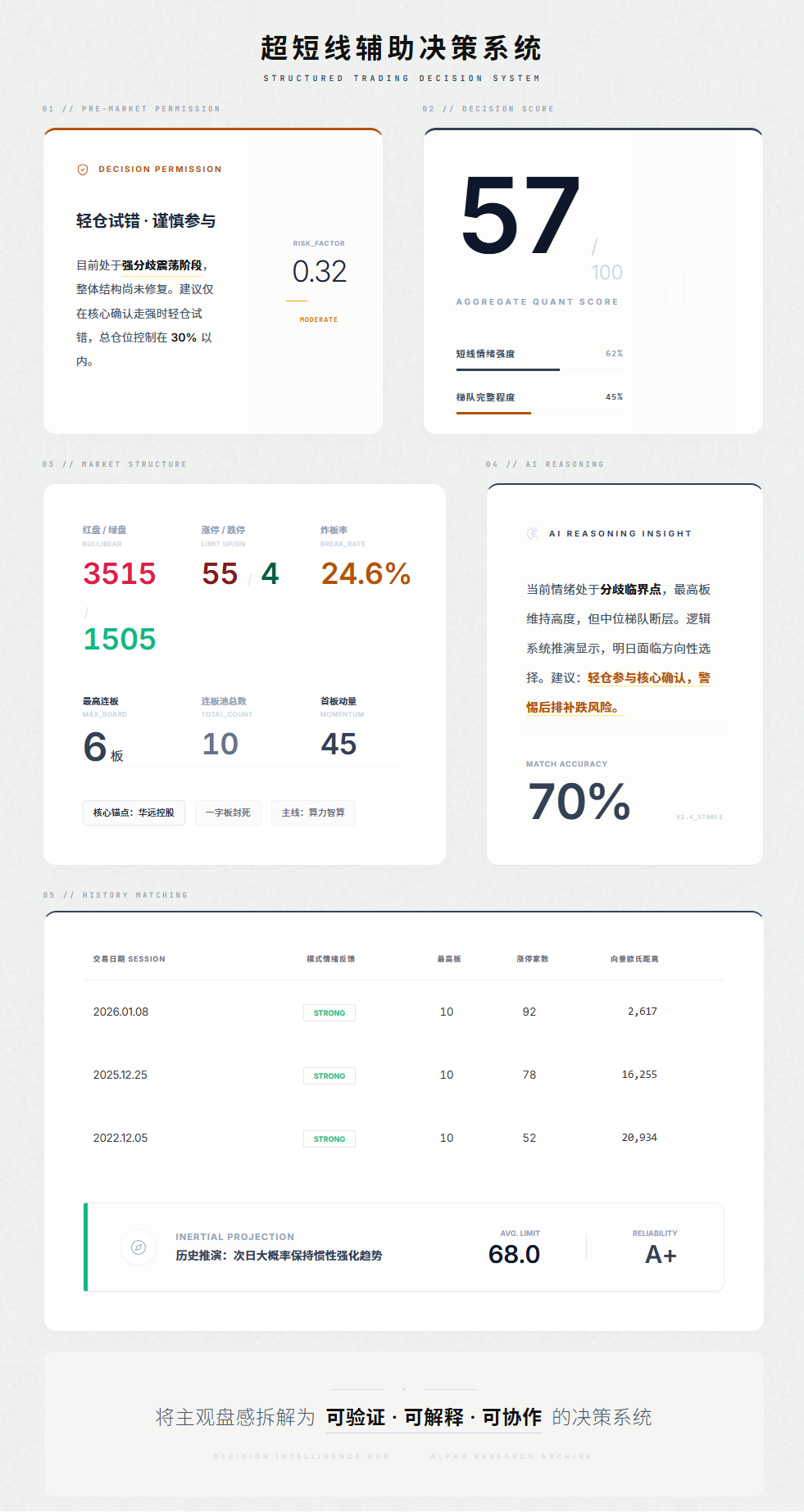
The Problem
Short-term market decisions are often driven by experience, intuition, and emotional judgement. After years of manual market review, I realized that many of my trading decisions relied on subjective pattern recognition that was difficult to explain, repeat, or compare.
The core problem was not whether I could observe the market, but whether I could turn scattered market signals into a structured system that helps reduce emotional bias and supports more consistent decision-making.
System Architecture
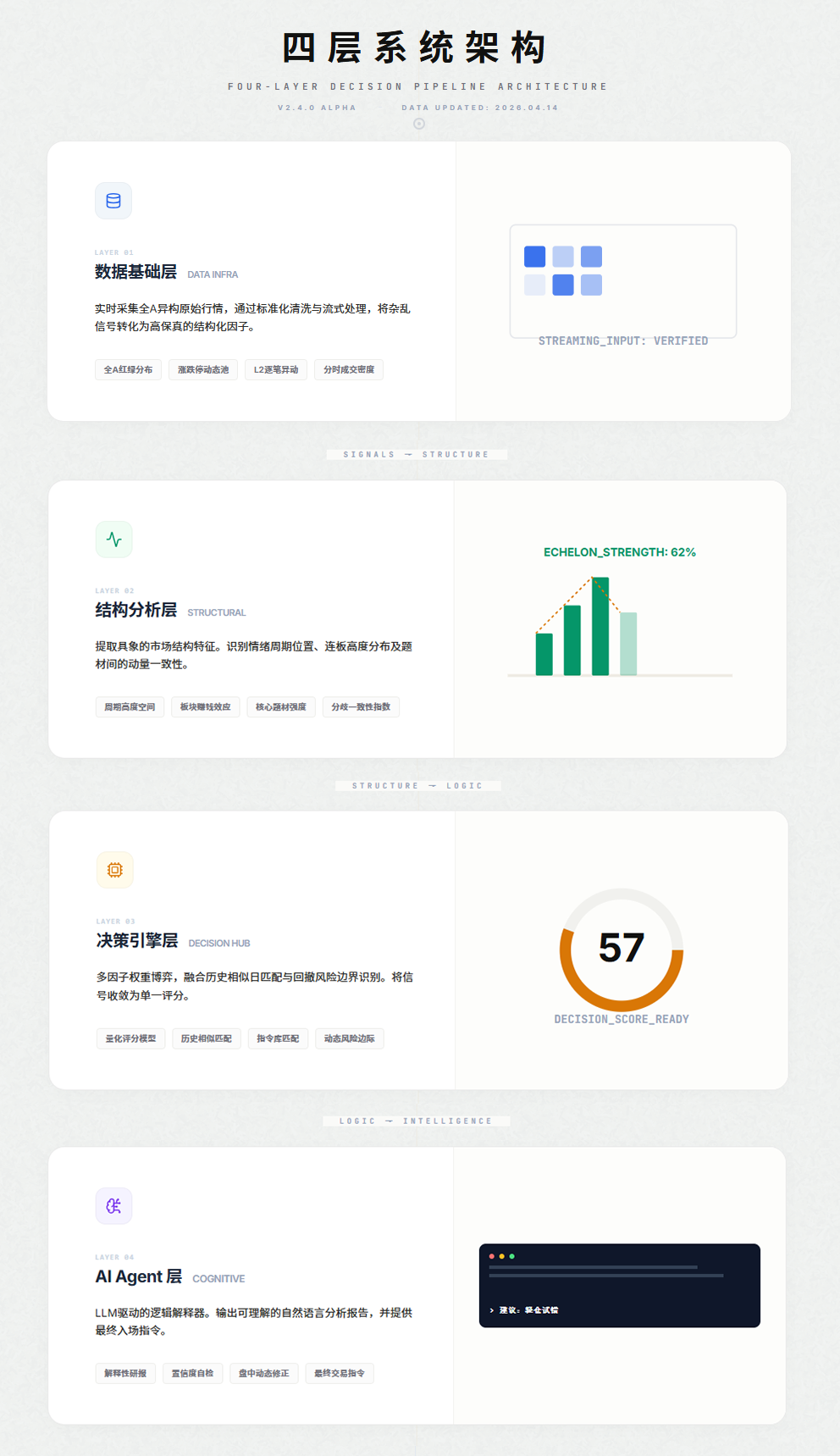
I organized the system into four layers: data foundation, structured market indicators, decision rules, and AI-assisted interpretation. This made it possible to transform subjective market observation into a repeatable and explainable workflow.
Layer 1 · Data Foundation
Historical market review records, daily emotional indicators, limit-up and limit-down counts, board structures, and similar trading-day data.
Layer 2 · Structured Analysis
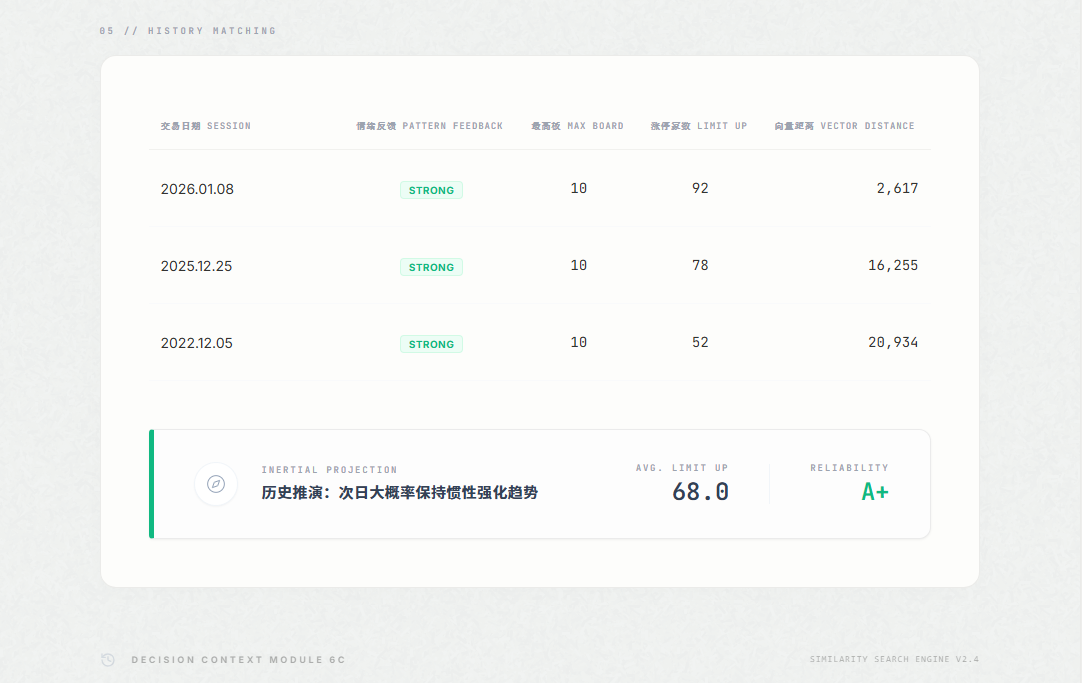
Market breadth, limit-up structure, emotional temperature, similar-day comparison, and short-term risk signals are converted into visible indicators.
Layer 3 · Decision Rules
Rules such as entry timing, risk control, stop-loss, take-profit, and market condition filtering are organized into a decision framework.
Layer 4 · AI Agent
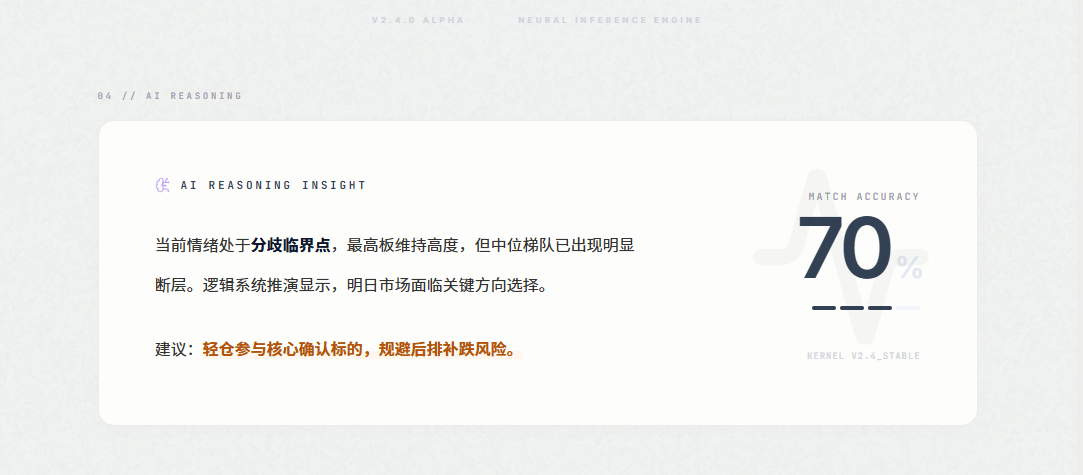
AI is used as an interpretation layer that helps summarize market state, identify risk, and generate next-day observation suggestions.
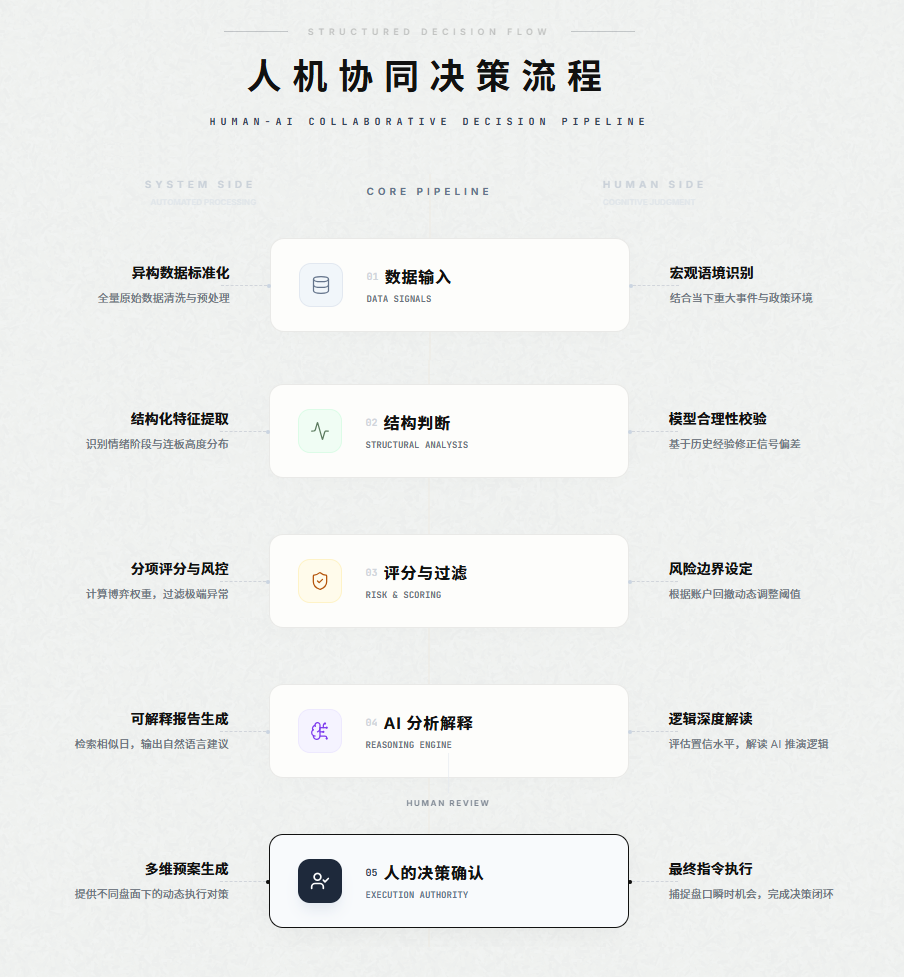
Human-AI Decision Flow
The system was designed as a human-AI collaborative process rather than an automatic trading machine. Human judgement remains responsible for final decisions, while the system provides structured observation, historical comparison, and risk reminders.
Core Modules
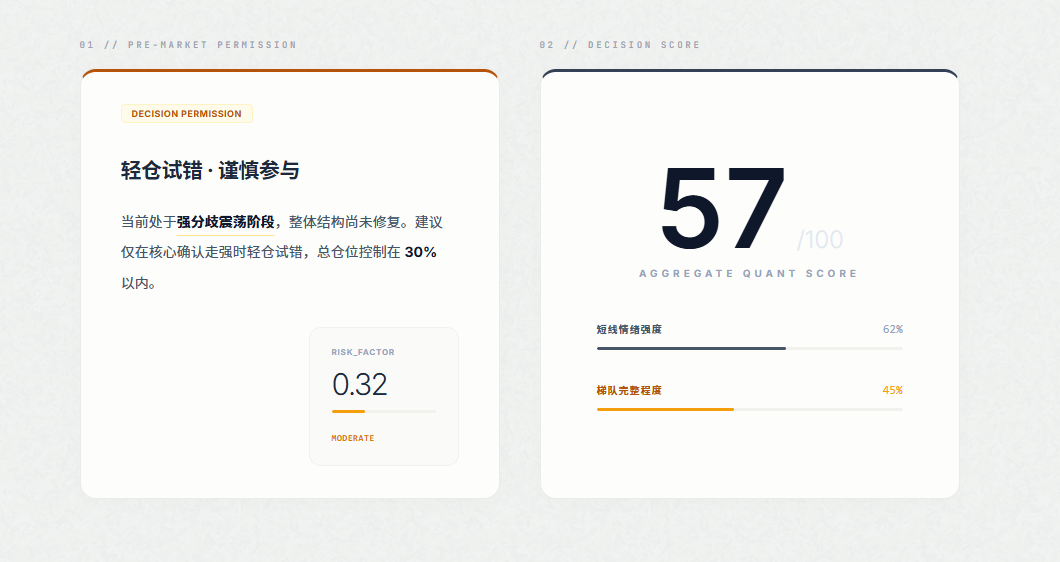
Trading Score System
The score system condenses multiple indicators into a single reference score, helping users quickly understand whether the current market environment is suitable for action.
Market Structure Monitoring
Market breadth, limit-up and limit-down counts, board height, and emotional indicators are displayed together to support a more complete understanding of short-term market structure.
Risk Filter
The risk filter helps identify moments when the market is too emotional, too fragmented, or too close to a high-risk phase, reducing the chance of making decisions based purely on excitement.
Design Decisions
The most important design decision was to avoid turning the tool into a dashboard full of disconnected numbers. Instead, I designed it as a decision funnel: market state first, emotional structure second, similar historical days third, and action suggestions last.
This top-down structure prevents users from selectively picking indicators that confirm their existing bias. It also creates a single decision source that keeps observation, judgment, and risk control in one continuous flow.
The product does not replace human judgement. Its value lies in helping the user slow down, compare conditions, and make decisions based on structured evidence rather than emotional impulse.
Technical Implementation
The system was built with Python, pandas, and Streamlit. Historical trading review records were cleaned and structured into reusable datasets, allowing the interface to display daily indicators, similar-day comparison, and decision summaries.
The implementation focused on quick iteration and explainability rather than complex modeling. This allowed the system to become both a personal decision-support tool and a portfolio project demonstrating product, data, and AI workflow thinking.
Reflection
This project helped me understand that AI Agent design is not just about connecting tools, but about structuring decision logic.
In a high-uncertainty environment like the stock market, the value of AI is not to give a magical answer, but to help organize information, reduce emotional noise, and make the reasoning process more transparent.
The deeper design question is how to divide responsibility between human judgement and AI assistance. This project became my first practical exploration of human-AI decision collaboration.